
Disabled people should be allowed to choose ease
Swapping resilience for something softer
Hello,
I have been thinking a lot about resilience.
On the one hand, I am deeply proud of both my own and the wider disabled community’s resilience. We are very good at getting back on the horse. We are very good at demanding better from a world that wants us to shut up. We are very (too?) good at seeing the funny side. And these are genuinely admirable qualities.
On the other hand, I am increasingly concerned about the price of it all.
If you find The View From Down Here valuable, please consider becoming a paying subscriber. Your support helps sustain this newsletter and directly supports my broader anti-ableism work - writing, community-building and advocacy aimed at making the world better for disabled people. Paid subscriptions make this advocacy possible in a world where marginalised people are often expected to work for free.
All my life, people have praised me for being resilient. I used to resent this because I didn’t think I was. I was chronically anxious. I cried a lot. I felt like I was failing all the time. I now see that, actually, I was resilient. I showed up and did things despite the anxiety and the crying, and, more saliently, despite the ableism and exclusion and physical pain I was braced for.
But you know what? I still resent being praised for it. Not least because, instead of being good at rolling with the punches, I would quite like the punches to, well, stop. It’s weird to be praised for a resilience that doesn’t feel good. It’s certainly not a free choice (what, exactly, is the alternative? To fall apart and never put oneself back together again? Then what, eh?). And it’s left my poor little nervous system - already doing quite a lot because of the literal brain injury I have - absolutely maxed out.
That nervous system has been, to put it mildly, on the blink recently, so I have been trying, perhaps for the first time ever, to dial down the volume. This has looked like things as varied as reducing sensory overload (which I didn’t even know I felt!), asking for a whole lot more help (this is hard), and saying no a lot more (possibly even harder). It has also involved asking even less of my body than I already did, and starting to ask a little bit less of my poor old brain, too. As is so often the case, it’s only in taking away some of the pressure that I’ve realised quite how much of it I was under.
Of course, none of these things can reduce the pressure of dealing with ableism, which is the biggest stressor of them all. But the idea is to reduce everything else so that, when I have to handle ableism, there’s some remaining bandwidth in the old nervous system with which to do so.
I think ableism also creates a specific pressure on disabled people to be ok - i.e. to be resilient. For me, this has a whole range of repercussions, some of which I have long been aware of and some of which, like the aforementioned struggle to make my own life easier, I am only just beginning to understand.
All of this makes me think a lot about the ways society puts both physical and emotional independence on a frankly bullshit pedestal. I have been making a version of this argument for a very long time (including, at some length, in the book) - mostly about how it devalues people who need care and makes all our lives less communal, and thus less happy, in the process. But I want to go a step further and ask whether - or perhaps. assert that - our insistence on independence is another way we expect and demand that disabled people perform resilience. And in doing so, how much damage are we doing to disabled people’s mental health?
Personally, I have noticed that over the past few weeks, as I’ve been feeling better and putting some of the things I’ve been learning about my CP/neurodivergence into effect, I have been shedding tears not when something bad happens but when people are kind (to me, or just on a random Instagram reel). For a little while, every time it happened, I thought ‘yikes, this can’t say anything good about me!’ But actually, I think it does. I think it says that my nervous system is craving more kindness, more gentleness, more softness, more relief. I’m hoping I find those things, and I hope all disabled people find them too.
Speak soon,
Lucy
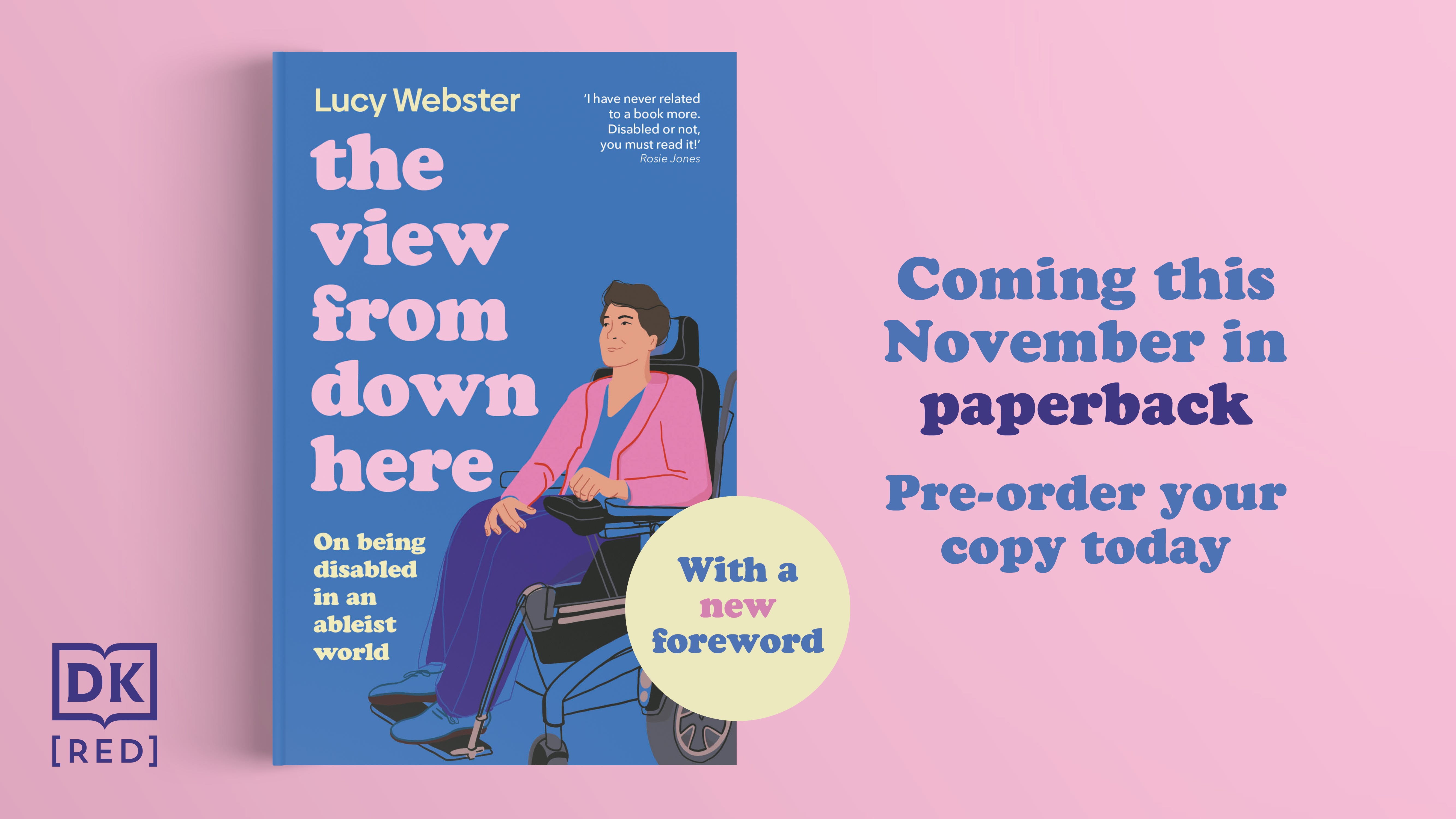
My book, The View From Down Here: On being disabled in an ableist world, is out now in paperback!
“A vital call to arms that demands we confront ableism at every level of society. Lucy Webster’s work is fierce, unapologetic, and essential - this is the blueprint for a world where all women belong.” - Sophie Morgan, TV presenter
“I have never related to a book more. Disabled or not, you must read it! Amazing. I love it.” - Rosie Jones, comedian
“A sharp, funny & deeply beautiful memoir that doesn’t shy away from the realities of disabled life and instead takes power from them.” - Ruth Madeley, actress